
The Catholic Imagination Conference
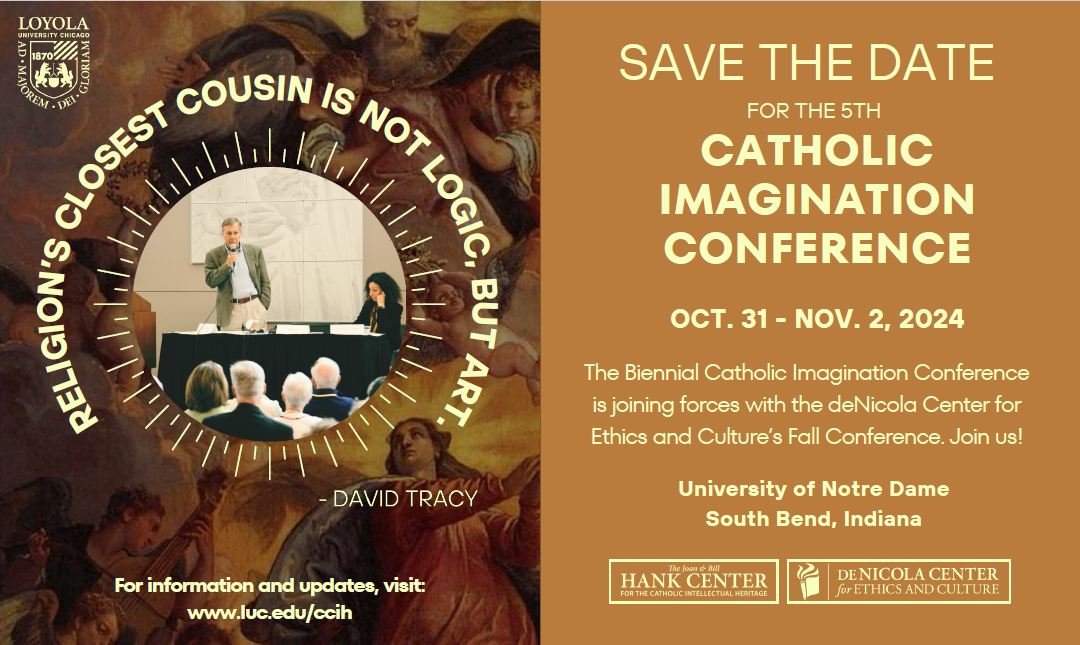
2024 Catholic Imagination Conference
October 31–November 2, 2024
University of Notre Dame, South Bend, Indiana
The Hank Center was proud to partner with the University of Notre Dame’s de Nicola Center for the Fifth Biennial Catholic Imagination Conference, "Ever Ancient, Ever New: On Catholic Imagination.” With a particular focus on the literary arts, this conference explored unique expressions of the Catholic imagination in more than 150 presentations, performances, and discussions across the disciplines including philosophy, theology, ethics, law, history, and the natural and social sciences, as well as the creative domains of film, music, theater, and the visual arts.
Fourth Biennial Catholic Imagination Conference
Along with Cowan Center at the University of Dallas and a host of others, the Hank Center was pleased to once again serve as a major co-sponsor of the Fourth Biennial Catholic Imagination Conference last fall. This one-of-a-kind conference was held from September 30 - October 1, 2022 in Dallas; and, in a style that is characteristic of this conference, the circle expanded, and the session rooms were bursting at the seams. More than 400 attendees delighted in an array of substantive speakers and topics, spent good time and treasure in the bustling book room, and shared lovely meals and conversation with one another. View the program, proceedings, and session videos by clicking the title of this post -- and we hope to see you for CIC Number Five at the University of Notre Dame in the fall of 2024. All are Welcome!

Third Biennial Catholic Imagination Conference
This international biennial conference, sponsored by Loyola’s Hank Center, featured over 80 writers, poets, filmmakers, playwrights, journalists, editors, publishers, students, and critics who explored a variety of questions surrounding the Catholic imagination in literature and the arts. What is the future of the Catholic literary tradition? What is the state of discourses in faith and Christian humanism in a world increasingly described as “Post”—postmodern, post-human, post-Christian, post-religious? How is Catholic thought and practice (or the absence of it) represented in literature, poetry, and cinema? If, as David Tracy observes, religion’s “closest cousin is not rigid logic, but art,” what might literary art be trying to communicate to its “cousin”—and to us all—as we travel along the first decades of the 21st century?